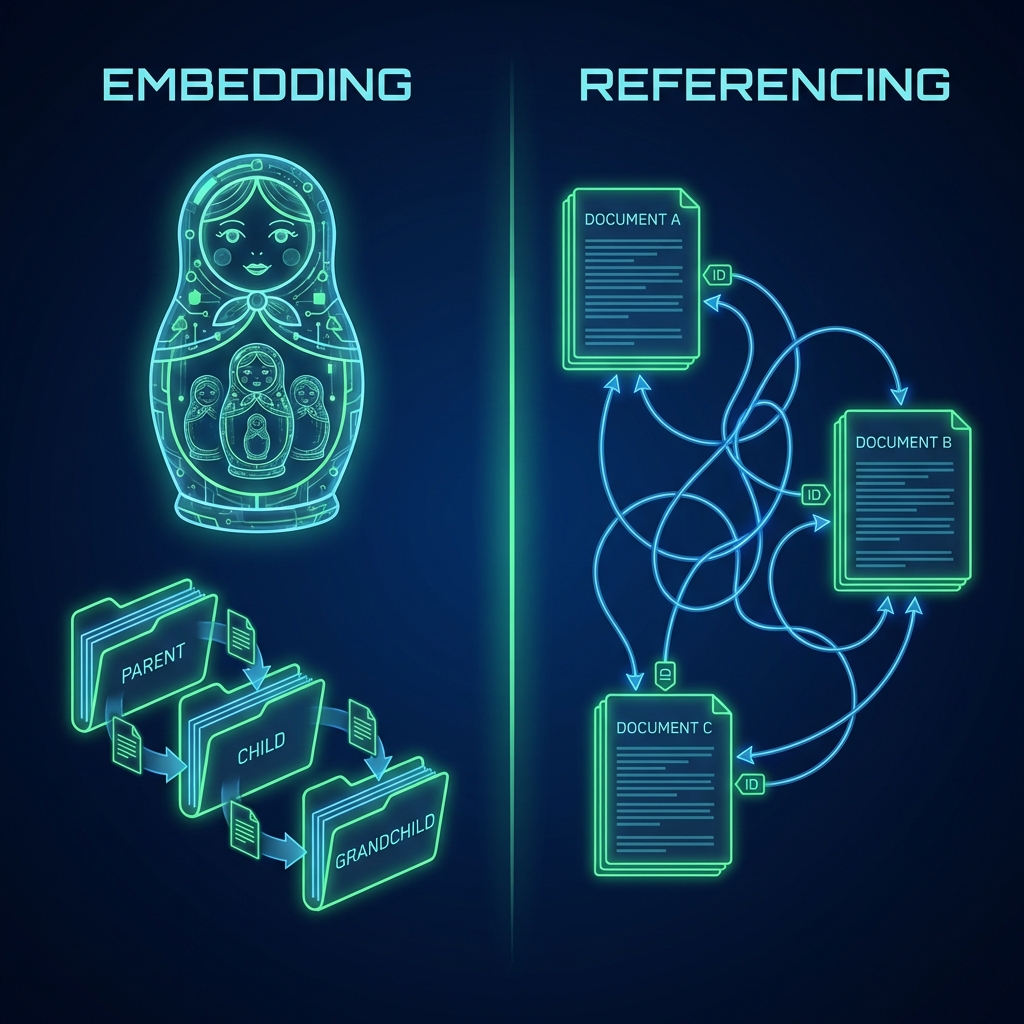
Embedding vs Referencing in MongoDB
Welcome to Day 1 of our 6-Week MongoDB Roadmap! 🚀
Today, we tackle the most common question for anyone coming from a SQL background to MongoDB:
“Should I normalize my data (Reference) or denormalize it (Embed)?”
In SQL, the answer is almost always “Normalize”. In MongoDB, the answer is “It depends on how you access your data”.
1. The Concepts
Embedding
Embedding is the practice of storing related data in a single document. This is the “natural” MongoDB way.
Example: A User has an Address.
// User Document
{
  "_id": "user123",
  "name": "Jane Doe",
  "email": "jane@example.com",
  "address": {
    "street": "123 Main St",
    "city": "New York",
    "zip": "10001"
  }
}
Pros:
- ✅ Performance: You get all the data (User + Address) in a single read query.
- ✅ Atomicity: You can update the user and address in a single atomic write operation.
Cons:
- ❌ Document Size Limit: MongoDB documents are limited to 16MB. You can’t embed an infinite list effectively.
- ❌ Duplication: If many users share the same address update, you have to update every user document.
Referencing
Referencing involves storing data in separate documents and linking them using an _id. This is similar to “Foreign Keys” in SQL.
Example: A Publisher has millions of Books.
// Publisher Document
{
  "_id": "pub999",
  "name": "O'Reilly Media"
}

// Book Document
{
  "_id": "book888",
  "title": "MongoDB: The Definitive Guide",
  "publisher_id": "pub999" // Reference
}
Pros:
- ✅ Flexibility: Useful for “Many-to-Many” or “One-to-Many” relationships where the “Many” side is huge (unbounded).
- ✅ No Duplication: Update the publisher details in one place, and all books reflect it.
Cons:
- ❌ Performance: Requires application-level “joins” (multiple queries) or using
$lookupaggregation, which is slower than a single read.
2. When to Use Which?
The decision often comes down to the One-to-N relationship rule.
| Relationship | Type | Recommendation |
|---|---|---|
| One-to-Few | 1 Person has ~5 Addresses | Embed |
| One-to-Many | 1 Blog Post has ~100 Comments | Embed (mostly) |
| One-to-Squillions | 1 App has 10M Activity Logs | Reference |
The “One-to-Few” Rule (Embed)
If the related data is small and rarely changes independently, embed it.
Example Code (Node.js/Mongoose):
const userSchema = new Schema({
  name: String,
  // Embedded schema
  addresses: [{
    street: String,
    city: String
  }]
});

// Storing data happens in one go
const user = new User({
  name: "Alice",
  addresses: [{ street: "123 Apple St", city: "Cupertino" }]
});
await user.save();
The “One-to-Many” Rule (Embed… Carefully)
For things like comments on a blog post. It’s great to read a post and its comments in one go. However, if a post can have 50,000 comments, embedding will hit the 16MB limit.
Solution: embed the first 100 comments for speed, and reference the rest! (Hybrid pattern).
The “One-to-Squillions” Rule (Reference)
For massive datasets, like logs or sensor data, always use references.
// Log Schema
const logSchema = new Schema({
  msg: String,
  timestamp: Date,
  // Reference to the source machine
  machine_id: { type: mongoose.Schema.Types.ObjectId, ref: 'Machine' }
});
Here, we store the machine_id in the Log document (Parent referencing), because the Machine document certainly can’t hold an array of 10 million Log IDs!
3. Practical Summary
- Embed by default. It leverages MongoDB’s strength.
- Reference if the embedded data would grow without bound (unbounded arrays).
- Reference if the embedded data is accessed standalone frequently (e.g., you query “Comments” without looking at the “Post”).
- Reference if you need to manage many-to-many relationships with high data integrity requirements.
🧩 Challenge for Today
Look at your current project’s database. Find one relationship (e.g., Users -> Orders).
- Are you referencing where you could be embedding?
- Are you embedding something that is growing out of control?
See you on Day 2, where we dissect the One-to-One, One-to-Many, and Many-to-Many patterns in code! 👨💻