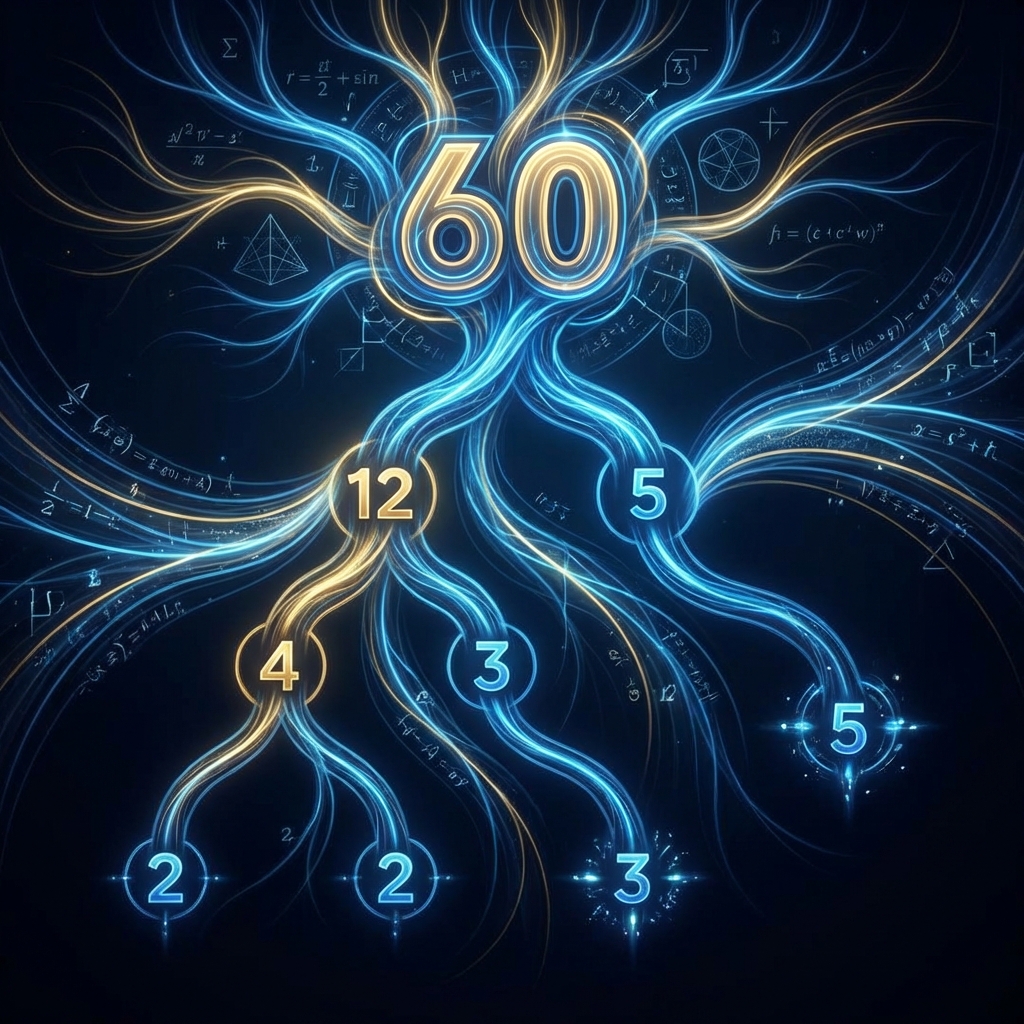
Week 1 Day 5: Prime Factorization - The Atoms of Numbers
We end Week 1 with the Fundamental Theorem of Arithmetic:
Every integer greater than 1 is either a prime itself or can be represented as the product of prime numbers in a unique way.
For example: $$ 60 = 2^2 \times 3^1 \times 5^1 $$
1. Why is this useful?
If you know the prime factorization of a number, you instantly know:
- Its divisors (number of divisors, sum of divisors).
- Its Euler Totient value (how many coprime numbers exist below it).
- Whether it’s a perfect square.
2. Algorithm: Trial Division
We can iterate from $d = 2$ up to $\sqrt{N}$. If $d$ divides $N$, we count how many times it divides $N$, and then divide $N$ by it.
Implementation
/**
 * Returns a map of prime factors and their counts.
 * Time Complexity: O(sqrt(N))
 */
function getPrimeFactors(n) {
    const factors = {};

    // Check for number of 2s
    while (n % 2 === 0) {
        factors[2] = (factors[2] || 0) + 1;
        n = Math.floor(n / 2);
    }

    // Check for odd numbers
    for (let i = 3; i * i <= n; i += 2) {
        while (n % i === 0) {
            factors[i] = (factors[i] || 0) + 1;
            n = Math.floor(n / i);
        }
    }

    // If n > 2 at the end, it is a prime itself
    if (n > 2) {
        factors[n] = (factors[n] || 0) + 1;
    }

    return factors;
}

console.log(getPrimeFactors(60)); // { '2': 2, '3': 1, '5': 1 }
3. Optimization with Sieve
If we need to factorize many numbers, we can precompute the “Smallest Prime Factor” (SPF) for every number using a Sieve. Then, factorization becomes $O(\log N)$.
We will cover SPF optimization in Week 5 (Advanced Tools).
🎉 Week 1 Complete!
You now have a solid toolkit:
- GCD & LCM for cycles.
- Euclidean Algorithm for speed.
- Sieve of Eratosthenes for mass prime finding.
- Prime Factorization for number properties.
Get some rest. Week 2 is about Modular Arithmetic, the clock math that powers cryptography! 🕰️