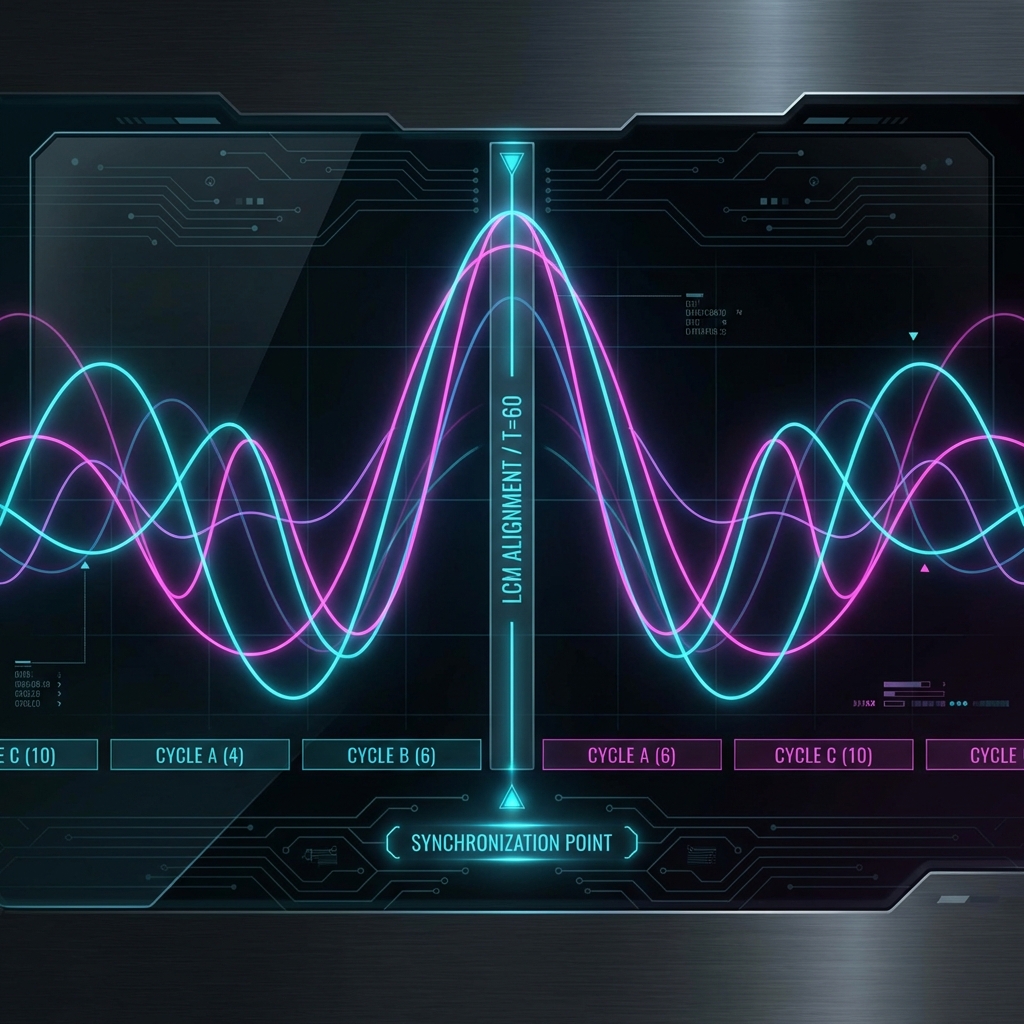
Week 1 Day 3: LCM in the Wild - Scheduling & Cycles
Today we take our new toy, LCM, out for a spin.
LCM is surprisingly useful in systems design and algorithmic problems involving periodic events. If you have independent cycles running at different speeds, LCM tells you when they sync up.
1. The Periodic Alignment Problem
Imagine you have three servers:
- Server A backups every 4 hours.
- Server B backups every 6 hours.
- Server C backups every 10 hours.
If they all just finished a backup right now, how many hours until they all backup simultaneously again?
Solution: We need a number $T$ such that $T$ is divisible by 4, 6, and 10. The smallest such $T$ is $\text{LCM}(4, 6, 10)$.
$$ \text{LCM}(4, 6) = 12 $$ $$ \text{LCM}(12, 10) = 60 $$
Answer: In 60 hours.
2. Implementing LCM for an Array
To find the LCM of a list of numbers, we can apply the LCM function somewhat sequentially: $$ \text{LCM}(a, b, c) = \text{LCM}(\text{LCM}(a, b), c) $$
JavaScript Implementation
function gcd(a, b) {
    if (b === 0) return a;
    return gcd(b, a % b);
}

function lcm(a, b) {
    if (a === 0 || b === 0) return 0;
    return Math.abs((a * b) / gcd(a, b));
}

function findLCMOfArray(arr) {
    let result = arr[0];
    for (let i = 1; i < arr.length; i++) {
        result = lcm(result, arr[i]);
    }
    return result;
}

console.log(findLCMOfArray([4, 6, 10])); // Output: 60
3. Classic Coding Problem: “The Jumping Frogs”
Problem: Two frogs start at position 0.
- Frog A jumps $X$ units.
- Frog B jumps $Y$ units. They want to meet at the same landing spot. What is the first coordinate (greater than 0) where they both land?
Answer: This is simply $\text{LCM}(X, Y)$.
Extension: What if Frog A starts at offset $O_A$ and Frog B at $O_B$? Now we are looking for a time $t$ such that: $$ O_A + k_1 X = O_B + k_2 Y $$ This turns into a Linear Diophantine Equation, which we will cover in Week 5! See how math topics connect? 🤯
4. Challenge for Tomorrow
We’ve dealt with one or two numbers. But what if we need to find prime numbers up to 1,000,000? Checking each one individually is too slow.
Tomorrow, we learn the Sieve of Eratosthenes, the ancient algorithm used to filter primes at lightning speed. ⚡
See you on Day 4!